
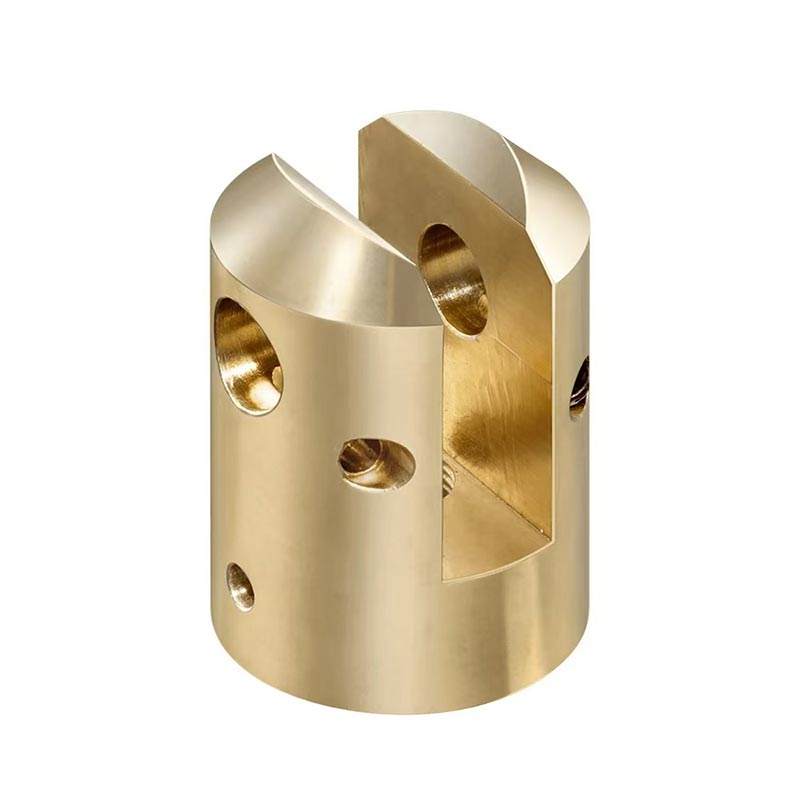
We use precision turning CNC machining brass parts. Whether you need a single sample or batch production of tens of thousands of pieces, CNC turning and milling machine processing can ultimately save money for the company by reducing labor costs, increasing production speed and minimizing material waste.

As a China physical factory with nearly 40 years of manufacturing experience, Losier focuses on the R & D and production of CNC Turning and Milling Machining Parts, providing high-precision, stable and reliable customized metal machining solutions for customers around the world. If you need to mass produce rotationally symmetrical parts such as shafts or bearings, the rotation speed and efficiency are excellent, making it ideal for large-scale production.

Our company also has the most advanced and complete testing equipment in the aluminum single base low pressure casting industry, including spectrometers, metallographic microscopes, tension testers, low-temperature testers, x-ray testers, MPT, UT, CMM, video measuring machines, etc.

As a leading permanent mold casting company, we specialize in manufacturing high quality permanent mold casting parts. With many years of experience, we have built a strong reputation for product quality and customer service.

With its extensive experience in aluminum alloy casting, iron casting, steel casting, precision machining, and mold manufacturing, Losier has become a trusted Chinese shell mold casting manufacturer and supplier for numerous overseas clients. Losier focuses on providing a one-stop supply chain service from shell casting → precision machining (CNC) → heat treatment → surface treatment → assembly, helping clients save at least 30% on overall costs and significantly shorten development cycles.

Precision investment casting is a highly accurate and versatile casting method used to create complex shapes that are difficult to produce by other methods. In investment casting, a wax pattern of the desired shape is created and then coated with a ceramic material to form a shell. The wax melts from the shell, leaving a hollow cavity that is then filled with molten metal to form the final casting.


