
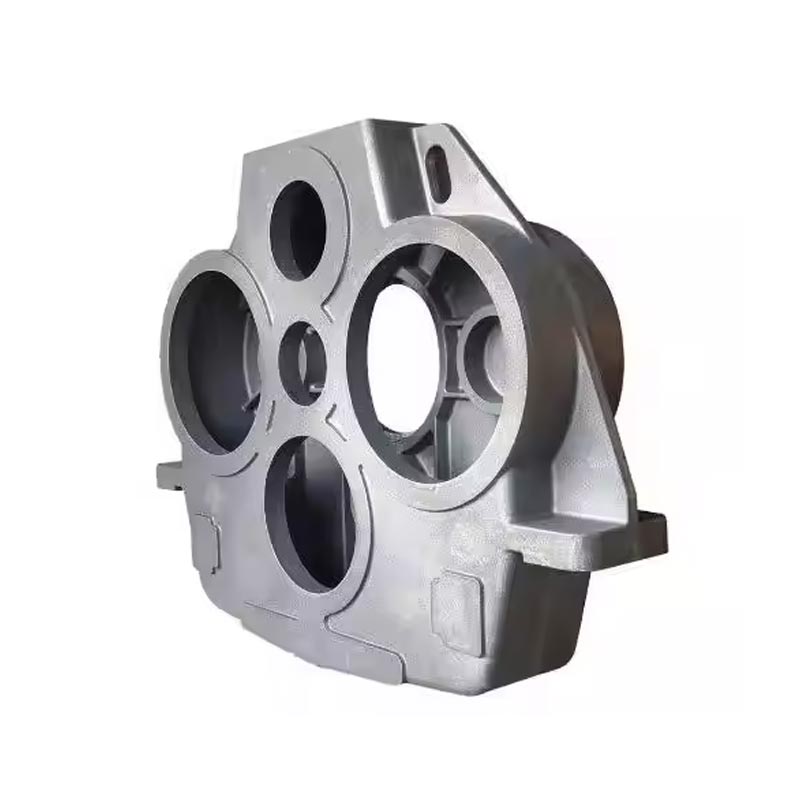
Custom Metal Cast Shell Mold Casting Parts are high-precision components widely used in automotive, machinery, and industrial applications. As a leading China manufacturer, Losier provides customized solutions with excellent dimensional accuracy, smooth surface finish, and stable quality for batch production. This process helps reduce machining costs, improve product reliability, and meet diverse application needs.


Custom Metal Cast Shell Mold Casting Parts are precision metal components produced using the shell molding process, where resin-coated sand is used to form a thin, high-strength mold shell around a pattern. Molten metal is then poured into this shell to create parts with excellent dimensional accuracy and smooth surface finish.
This process is ideal for manufacturing customized components with complex shapes, consistent quality, and high repeatability. It is widely used for medium to large batch production in industries such as automotive, machinery, valves, and industrial equipment, where strength, precision, and cost efficiency are critical.
| Product Name | Custom Metal Cast Shell Mold Casting Parts |
| Brand | Losier |
| Origin | China |
| Process Support | Shell Casting, Sand Casting, Die Casting, Investment Casting, CNC Machining |
| Main Applications | Automotive, Shipbuilding, Valves, Pumps, Construction Machinery, Power, Agricultural Machinery, Hardware, etc. |
| Available Services | OEM, ODM, Custom Processing |
| Drawing Format | DWG, DXF, STEP, IGS, STL, 3DS, PDF, JPG, Sketches, etc. |
| Sample Lead Time | 1–3 days (without surface treatment) / 3–5 days (including surface treatment) |
| Minimum Order Quantity (MOQ) | Negotiable |
| Size Range | Manufactured according to your 2D and 3D drawings |
| Tolerances | ±0.02mm or as per drawing requirements |
| Casting Roughness | Ra 1.6–Ra 12.5 |
Losier can process a wide range of metal materials, covering requirements from lightweight to high strength:
| Aluminum alloy | A356、ADC12、6061、7075 |
| Iron castings | Gray cast iron, ductile iron |
| Steel parts | Carbon steel, alloy steel, stainless steel |
| Copper alloy | Brass, bronze, red copper |
| Zinc alloy / Magnesium alloy | Zamak, AZ series |
| Project | Shell mold casting | Ordinary sand mold casting |
| Dimensional accuracy | High | Medium |
| Surface roughness | Good | Rougher |
| Unit cost | Slightly higher | Low |
| Batch cost | Lower | Unstable |
| Consistency | Strong | General |
| Applicable fields | Precision structural parts | General structural components |
Custom Metal Cast Shell Mold Casting Parts are widely used across various industries due to their high precision, durability, and cost efficiency. They are especially suitable for applications requiring consistent quality and complex geometries.
| Advantageous projects | Explanation |
| High dimensional accuracy (tolerance up to ±0.02mm) | Reduces post-processing and improves assembly accuracy. |
| Low surface roughness (Ra 1.6–12.5) | Superior to sand casting, even approaching some precision casting results. |
| Wide range of applicable metals | Suitable for aluminum alloys, iron, steel, stainless steel, copper, brass, etc. |
| Stable mechanical properties | High density, uniform structure, and low porosity. |
| Low mass production cost | Shell molds can be automated for high efficiency. |
| High consistency | High reliability of products in the same batch, suitable for mechanical parts and safety components. |
For applications requiring tighter tolerances and smoother finishes, Custom Metal Cast Shell Mold Casting Parts are generally superior. However, sand casting may be more suitable for very large or low-cost parts.
Shell molding may involve higher tooling costs and is less suitable for extremely large castings compared to sand casting.
Costs can be reduced by optimizing design, minimizing material waste, using batch production, and leveraging integrated services like those offered by Losier.
While initial tooling costs may be higher, Custom Metal Cast Shell Mold Casting Parts provide long-term savings through reduced machining, higher efficiency, and consistent quality in mass production.


